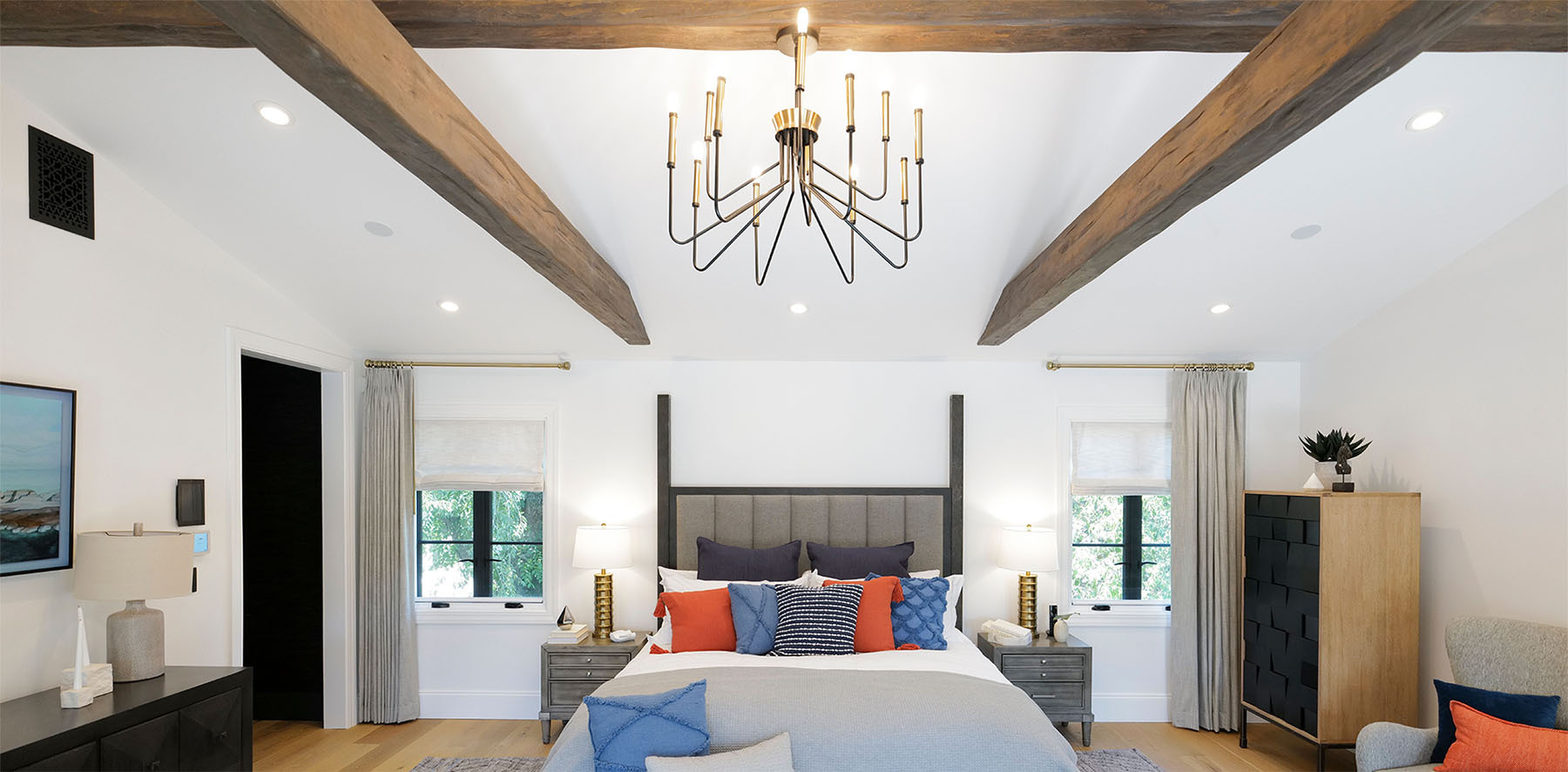
Think Beyond the Flat Stuff
by | Posted in Helpful Tip Tuesday, New Products No Comments »We write a lot here about faux brick and stone veneer, but let’s not forget faux wood panels. And while we’re at it, let’s not forget other coordinating faux wood materials like beams and corbels — which you can find at our sister site FauxWoodBeams.com.
| Two of our newest panels are Woodland and Raised Grain, and they’re each part of a larger family of faux products. The Woodland family includes custom beams, corbels and mantels. The Raised Grain family includes beams, corbels and scrolled-end beams. | ![]() |
| When you combine flat panels with solid beams and accessories in a single project, you can get really amazing results. The photo shows what one of our customers did with Raised Grain panels and beams to transform a high ceiling into an architectural feature that defines the entire room. | ![]() |
Winery on Wheels
by | Posted in Commercial Applications, Customer Design Projects No Comments »Here’s this custom trailer manufacturer that started out 32 years ago making horse and livestock trailers. And here’s this tasty little winery that started 11 years ago in the same region of North Carolina, transforming grapes into Chardonnay and Cabernet Sauvignon. Team these two companies together and you get — um, what do you get?
Nothing less than a fabulous wine cellar on wheels. That’s 18 wheels, including the tractor — custom manufactured by Golden Gait Trailers for Little River Vineyard and Winery. (Yes, that’s “gait.” Remember the horse trailers.)
But what does this have to do with artificial stone panels? The answer lies inside the glass doors that welcome you to the climate-controlled Little River mobile wine cellar.
![]() |
![]() |
Talk about a warm welcome. The Wellington Dry Stack artificial stone panels blend perfectly with the rich, natural wood and earth tones all around. “And the faux panels were much nicer than the website made them look,” says Golden Gait project manager Ben Hawkins. “That’s always a nice surprise!”
After an entrance like this, the wine racks themselves can’t be far away. And indeed they aren’t.
In the beginning, Little River was an out-of-the-way vineyard that sold most of its grapes to wineries in more populous areas. But eventually the folks at Little River asked themselves: “Hey, why should we sell our grapes to other people and let them win awards for their wine, when we could make the wine ourselves and do it just as well or better?” The problem would be getting the wine to the wine lovers.
The solution turned out to be a used trailer that Little River had bought — not for the trailer itself but for the generator mounted inside. Someone came up with the idea: “People aren’t going to go out of their way to come to us, so why don’t we use the trailer to bring the wine to the people?”
![]() |
![]() |
Little River and Golden Gait threw themselves into the project, and they’re justifiably proud of the result. They think of it as a time machine that transports customers back to one of the historic wine cellars of France or Italy.
And how can you have a historic wine cellar without stonework? The artificial stone paneling was the perfect way to add the right atmosphere in a place where real masonry was clearly out of the question. Real stone would be much too heavy. And it would be much too fragile, crumbling and cracking from the constant rumbling and stress on the trailer while traveling from place to place.
“We here at Golden Gait are professionals at turning dreams into realities, and this one is as real as it gets,” says Ben. And then adds, “All but the ‘rock,’ that is.”
To see more examples of how customers have transformed their wine cellar design with artificial stone panels, check out our Wine Cellar photo gallery.
Ganging Up
by | Posted in Helpful Tip Tuesday No Comments »When you cover a wall with fake stone panels, one of the classiest ways to treat electrical switches and outlets is to surround them with beveled stone frames. The frames are part of our Wellington line of dry stack fake stone wall panels, but you can use them with other panels as well. They come in seven colors, so you’re sure to find one that coordinates with just about any panel color.
Ah, but you say: “What about double and triple switches?”
I’m so happy you asked. The answer’s in the picture:
You see the trick right away. But let’s spell it out and fill in the details. First, for a double switch.
- You’ll need two frames for a double switch. And you’ll need a tube of matching textured caulk to form the “grout line” between the two frame pieces.
- Cut each of the two frames into a C shape, keeping the legs of the C as long as possible without cutting into the miters at the corners.
- Dry fit the two pieces together and lay your switch plate on top to check for size. You’ll want just enough space between the legs of the Cs to form a nice-looking grout line. If the legs are too long, carefully trim off a bit.
- You can assemble the two pieces in place on the wall, or on a work surface ahead of time. If you assemble them on a work surface, lay down a sheet of wax paper to work on. Apply a little grout to the ends of the legs, and position the pieces together so they’re square, even and properly spaced. Then carefully wipe the caulk to form a neat grout line. Leave the assembly undisturbed while the caulk firms up, and then handle it gently when you glue it to the wall the next day.
For a triple switch, you follow the same procedure, but you need to add straight pieces between the legs of the Cs to make the frame wider. So you end up with two grout lines top and bottom.
The good news is that you can cut these two extra straight pieces from the leftover bits of the two frames you’ve already cut. You don’t need to buy and cut up a third frame.
I Saw the Sign
by | Posted in Commercial Applications, Customer Design Projects No Comments »You never get a second chance to make a first impression. It’s a cliché for a reason: because it’s true. From a handshake, a smile, a good pair of shoes, you are judged at first glance—for better or for worse.
Same goes for your business. The sign out front—you know, the one that everyone can see when they drive by—is kind of like your interview outfit. (Yeah, I’m going to go with this tacky metaphor for a little longer, bear with me.) You want it to show off your personality, display your commitment, say, “I believe in what I do and am your best choice for this job.” So, don’t you want your sign out front to look its best? To be all tucked in and ironed?
We’ve had a bunch of people send in photos recently showing how they’ve used stone veneer panels to help their business’ signs reach their fullest potential. And we think this is such a great idea! After all, stone veneers are classy, professional, and varied enough to really show off your business’ point of view.
This gallery shows off our customers’ handiwork and is chock full of great ideas.
Love your current sign? Use faux stone veneer panels as a base support or bookended columns. The panels could also provide a cool backsplash or frame. Heck, why not get creative, like this hanging Texas sign which used stone veneer to make an overhead archway.
Veneer panels are great way to spice up indoor displays as well. Take them with you to company trade shows and be the baddest booth around (this is a good thing). The faux stone is lightweight enough to move from place to place, and will stand out against a sea of nylon banners printed at Kinkos.
But make sure you have a firm handshake ready; your sweet sign can’t be expected to do all the work.
A Window Fit for Rapunzel
by | Posted in Helpful Tip Tuesday, Makeovers, New Products No Comments »
You remember Rapunzel, right? A wicked witch shut her up in a tower with no stairs or door, and the only way up was to climb her long, braided, golden locks. “Rapunzel, Rapunzel, let down your hair!”
Hey, I’m not making this up.
The point is, what would the story of Rapunzel be if there weren’t a fabulous stone window for her to let down her hair from? And the point also is, now you too can have fabulous stone windows that Rapunzel would be proud to call her own. The only witchery involved is using faux keystones, trim blocks, trim strips and ledgers.
Here’s what the blocky pieces look like. There’s the full keystone that goes in the center, the left and right keystones that fit against the center one, and square trim blocks. You buy each piece separately, so you can piece them together as you like. The closeup shows the nice depth and texture.
With these four simple building blocks plus trim and ledger pieces, you can create just about any look you want, from the simple to the fanciful. Here are eight examples (click to enlarge).
But, you may ask, what about that nice arched window Rapunzel is leaning out of in the photo? Not a problem (click to enlarge).
So what are you waiting for? You don’t need a stone tower or even a fair-haired maiden to make this project an enchanting success.
Beautify an Ugly Retaining Wall
by | Posted in Helpful Tip Tuesday, Makeovers, New Products No Comments »
If the retaining wall in your yard is your pride and joy and the envy of all your neighbors, you can skip this tip.
In my case, my old railroad-tie retaining wall was so ugly, I finally had it ripped out and the whole yard re-graded to eliminate the need for it. But if I’d found this idea first, I would have given it serious consideration. I do believe it would have cost a heckofalot less.
The idea is to turn that ugly stack of railroad ties or poured concrete or masonry blocks into a nice faux stone wall. You know faux stone veneer works great outdoors, but you might not have thought of using it on this kind of wall.
The key to the project is not to just stick stone veneer on the front surface but to keep and enhance the look of a solid, thick wall. And you do that with wall caps. They absolutely make the whole project. They come in gray or tan to coordinate with just about any stone veneer you like, and they’re available in two widths for thick or extra-thick walls.
The wall caps are made of polyurethane just like the faux panels are, with all the same advantages of light weight, easy installation, and durable good looks.
The fact is, this is a project that delivers a lot of bang for the buck, and for the time and effort you put into it. You transform ugly into beautiful for a very reasonable investment of time and money, and have a blast doing it. It would even be a great starter project for someone who’s never worked with faux panels before.
Makes me wish I hadn’t torn out that old railroad-tie wall.
Of course you only want to do this to a retaining wall that’s stable and sound to begin with. If yours isn’t, then you may soon have more serious problems than your neighbor’s disapproving eye.
The Quicker Sticker Upper
by | Posted in Helpful Tip Tuesday, Makeovers No Comments »
One of the best things that’s happened to building construction in the past 15 years is the Insulating Concrete Form, or ICF. This interlocking system for sandwiching poured concrete between two layers of insulating foam is the greatest thing since … well, you know.
Anyway, once you’ve made one of these energy-efficient wall sandwiches, you need to cover it with something. And one of the options, for the inside or outside, is faux paneling. Naturally.
So here’s the tip. To cover an ICF wall with faux paneling, use the quicker sticker upper. Otherwise known as Handi-Stick®.
Handi-Stick is a cross between standard construction adhesive and spray foam. It comes in a cartridge, and you apply it with either a pro dispensing unit or a simple straw applicator. It comes out just like a bead of regular adhesive, but foamy.
So why use it? Because you can apply it to the back of a panel, press the panel in place on the wall, hold it flat for a minute or two, let go, and — you’re done. That panel’s stuck for good. Tight, flat, permanent. No drilling, no screwing, no screw holes to fill. Next panel, please.
Of course you do want to make sure you’ve marked exactly where it goes before you start squirting the Handi-Stick. That’s true of any fastening method, but with this one we really mean it. You’ve got five minutes to make contact with the wall, and then just a few moments to nudge it into its forever home.
Click to learn more about Insulating Concrete Formsand Handi-Stick.
New Fieldstone Style
by | Posted in New Products No Comments »We take all of the comments and suggestions we receive to heart. That being said, we’re happy to bring you a much-requested new style of artificial stone panels called Fieldstone.
Fieldstone (also known as Flagstone) is characterized by its artsy, mosaic style. One very distinct feature of Fieldstone is that it comes to you in pieces made from 4 different molds, resulting in a less uniform and a more randomized, natural look. Flat stones of varying shapes and sizes are arranged organically, like natural puzzle pieces, creating a lovely, old New England feel, indoors or out.
Another important note about Fieldstone is that it is the only one of its style on the market that’s made of polyurethane – not concrete. So you’ll have no problem installing it yourself, no mason needed!
And as usual, we have tons of color options to choose from. Use Desert Sky’s mix of dusty reds and beiges to add warmth to your dining room, or the deeper grays and steels of the Smoke style to build a new fireplace.
As with the rest of our faux wall paneling and siding, you can install these all by yourself—or with a friend—without a mason. And the Fieldstone panels interlock both vertically and horizontally, just like a real tongue-and-groove installation. Check out more details and installation tips here.
Comment below with how you think Fieldstone will work to meet your decorating or remodeling needs, or post a review to help other readers make a choice. We want to hear from you – we really DO listen!